Pages

Saturday, June 11, 2016

How to Catch and Cook Sikling (Plain Bush Hen) at the Fish Farm


How to Catch and Cook "Sikling" (Plain Bush Hen) at the Fish Farm

Last week, the son of my fish farm overseer caught a rail bird (locals call it “sikling” in Pangasinense). It’s properly called plain bush hen in English, (Amaurornis olivacea, scientific name).


It’s one of the more familiar bird species seen at the bangus and tilapia ponds in our farm. From afar, they're the medium sized black birds so often seen, we tend to ignore them. 
 
After the bird was caught, and I had a closer view, I realized it's not all black. The plain bush hen is about 10-12 inches long, has black head, nape, back and tail with grayish underparts (breast and belly), with blue tinge at the underwings, yellow legs with grey band at the upper legs, and yellow greenish bill with orangish patch below forehead.

A bush hen ("sikling") hanging upside down to expose the underwings

Same "sikling" bird (see above photo) shown on its side for close-up view

We don’t consider them as pests as they tend to just stay at the clumps of grass at the sides of our ponds and in adjacent fresh water ponds. 

"Sikling" birds (middle left of photo) at the water edge

At other times, we can see them swimming in the pond in small clusters. They usually eat insects, earthworms, seeds at the bottom part of earth dikes, and other tiny creatures along the fish pond water edge.

During dry season, when the water level in the ponds go down, especially the fresh water ponds next to ours, we see groups of plain bush hens frolicking in the grassy or "kangkong" (swamp cabbage)-filled shallow ponds.

 Plain bush hens seen from afar (small black objects among the vegetation in the pond)

I learned from my overseer that her father often serves sikling for meals when she was a child According to her and her son, there are actually four types of bush hens that they observe. These are:

· Plain “sikling” - remain on land (generally terrestial) and at the sides of ponds, creeks and irrigation canals. In our fish farm, they don’t usually fly and just make their own bird passage (tunnel-like) along the weed-covered dikes.

· “Sikling kerek” – are seen swimming in our ponds and fly high when disturbed.

· “Sikling butot” – swim in ponds but fly low when under threat.

· White-breasted “sikling” – they have seen this but is rare in our locality. I've not seen it but it's possible that this looks like a "sikling" bird but is of a different species (possibly a waterhen).

Other birds we have at the fish farm are the cattle egrets (called “nursing” by the locals because of their all-white exterior, also called
"dulakak" in Pangasinense). They can be seen foraging in the shallow water ponds for water insects or even small fish. At night they roost on the branches of the narra trees at the southern part of our Main Pond. Else, they fly and choose some fronds of the coconut trees for their evening roost.

Another ubiquitous bird that seems to be a trademark fishpond bird in our farm is the pond heron (“doroko” in Pangasinense). They can be seen perched on low branches of trees or top of bamboo stakes, waiting patiently for prey, and are swift to swoop down on a small fish swimming near the surface. They are colored grey and are bigger than the bush hen.

Later I’ll document more local bird species that frequent the farm.

Going back to the plain bush hen ("sikling"). What’s interesting about them is that the locals do consider them as delicacies. Traditionally, they are cooked as adobo or with "gata" (coconut milk).

I became curious about how our farm locals catch, dress, and cook the plain bush hen (“sikling”).

Procedures:

1. Catch the bush hen at the ponds.

My overseer’s son spotted a group of bush hens. He walked over to the pond spot where the bush hens were feeding. He ran after them, and the birds took off in flight. Because they tended to fly very low near the ground, the son merely struck a thin branch of tree in the direction of the fleeing hens and hit one bird.

2. Pluck the feathers of the newly killed bird by hand.

No need to use hot water to do this.

3. Put the bird’s body over a flame in the clay oven to completely burn off the remaining feathers.

The resulting carcass is singed all throughout and looks like scorched black meat.


"Sikling" birds with scorched flesh ready for cutting

4. Rinse the burnt flesh.

5. Cut off the feet and the head. Remove the oil gland by cutting off the flap at the bird's tail. 


6. Remove the guts.

7. Cut lengthwise along the chest.


Bird's body being cut into halves lengthwise
7. Keep the gizzards and livers.


8. Wash thoroughly inside and outside the bird's carcass, making sure that no blood or tissue remains.
 
9. Cut off the thighs. Cut the halved part into smaller pieces.


Cutting off thighs

Cutting body into smaller serving pieces
10. Prepare garlic, onions, and plenty of ginger. Crush the ginger and garlic and dice them.

Cutting lots of ginger, later crushing them


Cutting onions

11. Saute the garlic, ginger and onion in a pot with cooking oil.


Sauteing garlic, onions, ginger

12. Put the cut parts of the "sikling" meat into the pot and cook.


Cuts of "sikling" meat being cooked with sauted onion, garlic, ginger

13. When the "sikling" meat is almost dry and the spices absorbed into the cooked flesh, add soy sauce, bay leaves and pepper corn and a dash of flavor enhancer.

14. Cook some more until meat is tender, then add local vinegar (nipa or sugar cane). Cook until the adobo boils. Do final taste test, add condiments as needed. Let simmer, then serve hot with newly boiled rice.


For a complete list of Fish Pond Buddy blog posts on fish farm-related topics, please click the Index page.

Tuesday, June 7, 2016

How My Fish Farm Overseer's Niece Gave Birth for Free!


How My Fish Farm Overseer’s Niece Gave Birth for Free!

My fish farm overseer has a niece. My daughter hired her as nanny in Quezon City, Philippines. Recently the niece, who is from Pangasinan, became a single mom. She got pregnant by her boyfriend, who works nearby


All of us were taken by surprise when we learned she was pregnant. My daughter learned about it less than 2 months before the nanny gave birth. The niece had always said she was just fat and just got fatter. She hardly took time off from work.

Quite recently my daughter learned, through the doctor, that her nanny will give birth third week of May. So we planned to drive her home to Santa Barbara, Pangasinan where she can be with her parents when her time comes.

But then it turned out she was due much earlier than that. Yesterday, April 28, the nanny gave birth to a baby boy. Good thing my daughter already had plans to take her to a lying-in clinic. The clinic hesitated (because the nanny's baby may be premature), and instead referred her to a nearby government medical center for check-up.
 

The nanny was taken to the Quirino Memorial Medical Center (QMMC), a government hospital, in Quezon City, where she was admitted. A couple of hours later, the doctors helped deliver her baby boy.

Niece’s Background

Elsa is 19 years old whose poor parents in Sta. Barbara, Pangasinan work as farmers. She has 6 siblings.

Since my daughter hired her, Elsa had been a great help to her parents financially. She sent them money regularly. She worked as nanny for my daughter’s 11 month-old daughter.

Being unmarried and below 21 years old, Elsa is supposed to have health insurance coverage as dependent of her mom, who Elsa knew is a Philhealth member. Her mom is also a beneficiary of the Philippine Government’s 4Ps (a poverty alleviation program). Under this program, the government gives cash to the poor. In exchange, the poor parents keep their young children longer in school and send them to health centers for regular check-up


All 4Ps beneficiaries are automatically covered by Philhealth.

When Elsa got pregnant, her world turned upside down. My daughter will lose a trusty nanny. Elsa will lose her job because she’ll have her baby to take care of. Elsa’s parents in Pangasinan will lose the regular cash remittances sent in by their daughter. She’ll also face uncertainty once she delivers her baby. How much does it cost to deliver her unborn child, where will she go, who will attend to her, how will her family take the news?

How Government Helps the Poor

Fortunately all was not lost for Elsa during her crisis. With my daughter to help out, she was admitted to a government hospital (QMMC) which took in Elsa without any fuss. And after a few hours in labor, she delivered her baby boy.

Most importantly, Elsa didn’t have to pay a single peso for the hospital charges and doctor’s fees for herself and her newborn. I myself knew this because I personally worked out all documents and paper work.


Hospital charges and doctor's fees for the infant; actual charges less amount absorbed by Philhealth is a net payable; this amount was waived by the hospital and patient was discharged for free

Hospital charges and doctor's fees for the mother; actual charges less amount absorbed by Philhealth is a net payable; this amount was waived by the hospital and the mother discharged for free

All costs were borne by the government courtesy of the Philippine Health Insurance Corporation (Philhealth). It's a government-owned, controlled corporation set up to provide universal health coverage for Filipinos. 


When we brought Elsa’s case to the Philhealth desk at the QMMC’s Admitting Section, the attending staff learned that she’s only 19 and single. But they can’t find her mother’s member data record, as principal member, in their Philhealth online systems. 


Normally this would have caused major problems for Elsa. She has no Philhealth coverage. Her mom, who she knows has one, for some reason, can't be located in the Philhealth system. So she can’t rely on her mom too.

Fortunately, the QMMC’s Social Welfare Office enrolled Elsa as a hospital-sponsored member. The Office gave her a one-time free health insurance coverage, through Philhealth, up to December 31, 2016. Which means she got entitled to free hospitalization, for herself and her newborn. The only condition: Elsa commits to pay the annual insurance premium of Php2,400 for 2017 and beyond.
 

To work out the free hospitalization for Elsa and her newborn, we had to patiently comply with QMMC’s document requirements, fill out all the needed forms, and go to various offices in QMMC.

Documents

I assume that the documents and procedures below are common among government hospitals. I may have missed some but these are what I recall doing after one full day’s work, assisted by my fish farm overseer, Elsa's aunt.

1. Patient Slip (PS) – Upon arrival at the hospital, the mom who is due to deliver her child is brought to the Admitting Section (AS). The AS staff gives the patient a Patient Slip. The patient (or companion) then writes her complete name, address, birth date, name of parents, contact number. This is the basis for filling out the ADR below.

2. Admission and Discharge Record (ADR) – a form issued by the Admitting Section based on the patient information written in the PS.

3. Patient’s Rights and Obligations

4. QMMC (Hospital) Rules and Regulations - The rules cover visiting hours, dress code for visitors, food, bringing personal effects, cleanliness, correct use of facilities, security peace and order, attending to hospital bills, discharge of patient.

5. Temporary Certificate of Live Birth – to be filled out in two copies in black ball pen by spouse, parent or guardian. This form has 3 parts:

(a) child information – name, sex, date of birth, place of birth, type of birth, birth order, weight at birth

(b) mother information – maiden name, citizenship, religion, number of children born alive, children still living including new born, occupation, age, residence

(c) father information – name, citizenship, religion, occupation, age at time of birth. Note: In Elsa's case this was left blank, the infant was named using her surname.

(d) other information such as date and place of marriage of parents, if applicable, attendant (physician, nurse, midwife, traditional midwife (hilot), others), and certification of birth by attending obstetrician as to time, with signature

Notes:

(a) if parents are married, they need to submit their Marriage Contract to the hospital’s Records Management Office (RMO) within 7 days from birth of newborn.

(b) if parents are not married, father should acknowledge his child within 7 days from the child’s birth date by submitting the Affidavit of Acknowledgment and the original and photocopy of both parent’s individual Community Tax Certificates to the RMO.

(c) Hospitals are required to register the Certificate of Live Birth before the 30th day and that if the child was not acknowledged by the father, the child will use the surname of the mother. Note: this is what we did.

This form needs to be signed by the infant's mother or father. The parent (s) confirm correctness of the information written on the temporary birth certificate. That they agree that the hospital will not be liable for any typo error or omission of details not recorded on this form.

6. Philhealth Member Registration Form (PMRF) (for patient herself who is a Philhealth member, or patient’s parent who is a member)

7. Philhealth Member Registration Form (PMRF) (for filling out basic personal info on mother and baby) – given to a qualified mother who is not yet a Philhealth member but is given a one-time free Philhealth insurance coverage until end of the year so that her hospitalization costs are absorbed by Philhealth. Note: Elsa falls under this category.

Note: Above PMRF form has 3 parts: (a) member information (b) declaration of dependents (c) membership category

8. Philhealth Claim Form 2 – consists of 4 parts: (a) health care institution information, (b) patient confinement information, (c) certification of consumption of benefits and consent to access patient records (d) certification of health care institution

This form is to be filled out by the attending doctor/nursing station indicating among others (a) admission diagnosis (b) discharge diagnosis (c) type of applicable package (like newborn care package) and the list of care procedures, tests, vaccinations administered

Essential Newborn Care

· Immediate drying of newborn

· Early skin-to-skin contact

· Timely cord clamping

· Eye prophylaxis

· Weighing of newborn

· Vitamin K administration

· BCG vaccination

· Hepatitis B vaccination

· Non-separation of mother/baby for early breastfeeding initiation


Note: It was  reassuring to know that the above newborn care procedures (which I learned are up to current standards) were done for free for Elsa's baby or for any other newborns.

Newborn Hearing Screening Test

Newborn Screening Test
 

Note: above tests are applicable to maternity/childbirth cases and were done for Elsa's infant.

Patient, member, or authorized representative is required to sign under “Consent to Access Patient Records”.

9. Certificate of Live Birth (CLB) – this form is issued by the Nursing Station to the spouse, parent or guardian of the new mother. It’s a form for the Office of the Civil Registrar of the city or municipality where the infant was born. It’s to be accomplished in quadruplicate. The procedure is to take the 4 blank CLB forms together with the Temporary CLB to the Records Management Office which will type in the required information on the CLB.

Like the Temporary CLB, the CLB has 3 parts: child information, mother information, father information

Once the CLB is fully accomplished and typed, it will be photocopied and a certified true copy is given to the patient upon her discharge. The registered CLB itself will be available to the mother/father after 5 weeks from date of birth of the child.

10. "Alagang Pinoy Tagubilin" – this is a form filled out by the Nursing Station and given to the mother prior to discharge. It indicates the appointment date and time for the post-delivery check-up of the mother.

11. NICU Discharge Instruction – this is a form also filled out by the Nursing Station and given to the mother before her discharge. It indicates the appointment date and time for the post-delivery check-up of the baby.

This form also shows date of birth, time of birth, type of delivery, antropometric measurements at birth such as head circumference (HC), chest circumference (CC), abdominal circumference (AC), length (L) or newborn height (NH), and weight (W), final diagnosis, date and type of vaccinations given at birth (like Hepa B vaccine and BCG vaccine), date of newborn screening test given.

12. Patient’s Statement of Account (for mother) – this form is prepared by the Billing Clerk at Administration Office and certified correct by an Administration Officer. 


It shows name of patient, health record number, address of patient, date of admission, time of admission, number of days confinement, age of patient, the details of hospital charges, due from Philhealth and net amount payable, also the professional fees (showing name of physician, actual charges, due from Philhealth, and net amount due).

13. Patient’s Statement of Account (for newborn) – this form is also prepared by the Billing Clerk at Administration Office and certified correct by an Administration Officer. 


It shows name of newborn, health record number, Philhealth number of mother, confinement period, details of hospital charges, amount absorbed by Philhealth, the net amount payable, also the professional fees less amount shouldered by Philhealth and net amount payable, if any.

14. Barangay Clearance – issued by the Barangay where mother is a resident and shows name, address, date of birth, place of birth, purpose for issuance (for Philhealth), remarks (such as no derogatory record), clearance number, validity. The Barangay Clearance is approved by the Barangay Head. This is a required document at the Admitting Office and serves as identification, in absence of IDs or birth certificate.

15. Philhealth CARES Verificaton Slip – CARES stands for Customer Relations, Assistance and Empowerment Staff. She is a registered nurse under the employ of Philhealth deployed to accredited level 3 and 4 hospitals to provide customer assistance to Philhealth members. The CARES staff helps the members avail of their benefits outright.

At the QMMC, the CARES has a dedicated Philhealth desk at the Admitting Section and is just beside the Social Welfare Office. 


The staff answers questions about Philhealth. She explains Philhealth policies and rules, benefits, membership procedures, and other information that members may need. She talks to the patient’s spouse, parent or guardian on the patient's background, categorizes the patient, and gives instructions on how Philhealth benefits can be applied.

The CARES staff logs on to the Philhealth online systems to verify member data record and to establish member eligibility.

The Philhealth CARES Verification Slip is a form prepared by the CARES staff after verifying the member data record and eligibility using the Philhealth online systems. The staff also indicates the membership category of the patient (sponsored member, OFW, etc.) after her interview on the patient's background.

The staff gives the  completed Verification Slip to the spouse, parent or guardian for submission to the Social Welfare Office for processing.

16. Philhealth Point of Care Certification (PPCC) – This is a certification form filled out by the Social Welfare Office based on the CARES Verification Slip issued by the Philhealth CARES desk.

The PPCC shows the name of patient, date of birth, address, and date the patient is enrolled as a hospital sponsored member. It’s prepared by a social welfare officer and approved by the Head of the Medical Social Service.

The PPCC shows that the patient is eligible to become a sponsored member. By being a sponsored member, she will have insurance coverage until end of the year (validity date).

Note that a sponsored member is someone whose Philhealth insurance contribution is paid by another entity (such as a government hospital). This privilege is given only to qualified patients such as:

· Those coming from the informal sector in the low-income bracket

· Orphans, abandoned children, abused minors, out-of-school youth, street children, persons with disability, senior citizens, and battered women

· Barangay health workers, nutrition scholars, barangay tanods, and other barangay workers and volunteers

· Unenrolled women who are about to give birth, if such women are indigent as determined by CARES.

Elsa, my daughter’s nanny and my fish farm oversee's niece, who is single, pregnant, and whose family is indigent, falls under the last category.

17. Patient’s Identification Card – issued to a discharged patient showing the health record number and name of patient. It will be presented to the Outpatient Department when the patient comes back for check-up.

18. Medicine Slip – Issued to the patient showing the amount of medicine allowance granted (such as Php1,000). The Medicine Slip is taken to the Pharmacy together with the original copy of doctor’s prescription. The Pharmacy fills out the cost of medicines actually given to the patient. All subsequent issues of medicines are costed and entered in the Medicine Slip until the allowance is fully used up. 


My daughter's nanny received a medicine allowance of P1,000 and got her prescribed medicines for free.


After Elsa gave birth, we took her to our house in Quezon City where she and baby recuperated for two days. On May 2, we drove her and her newborn to Elsa's parents at Sta. Barbara, Pangasinan.

Note: Recently, we were informed that the boyfriend made good his promise to support Elsa and her newborn. He has been sending financial support since Elsa gave birth.


For a complete list of Fish Pond Buddy blog posts on fish farm-related topics, please click the Index page.


Common Medicinal Plants, Fruits, Trees in the Fish Farm


Common Medicinal Plants, Fruits, Trees in the Fish Farm

Most rural folks in our farm village have access to basic health care, medical consultation or even hospitalization. 


A few hundred meters away is barangay (village) health center staffed by a nurse and health workers. Also a bigger health center at the town proper with doctors and nurses.
 

For hospitalization or child birth, they go to the provincial hospital in San Carlos City or the regional hospital in Dagupan City. Both hospitals often give free doctor’s and hospital services, except medicine (which can be bought at reduced prices if one is indigent). For child birth, there are lying-in clinics in the village. Pls. see also my blog post on "How My Fish Farm Overseer's Niece Gave Birth to her Newborn for Free!".

For simple illnesses, such as headaches, colds, cough, body pains, etc., low-priced generic or even branded over-the-counter drugs are available at the local drug stores.

 
Yet, rural folks often tend to turn to medicinal plants, fruits, and trees to cure common illnesses. When they get sick, the younger ones seek advice from their elders who prescribe herbal treatment just as their ancestors did. Plants, trees, or fruits which can relieve or treat illnesses are just around the house, as they say.

“Eat this fruit, boil this bark and use it for bathing, drink this tea, pound these leaves into a paste and apply on your sore body, etc…..”

My "hilot" (local massage therapist) like Ka Virgie, is herself a strong advocate of herbal medicine. Click this to see my blog post on "Traditional Healing in the Fish Farm". She uses indigenous plants and trees commonly found in the farm and around the village.

Before our "hilot" session, Ka Virgie, my farm overseer, her visiting mother, and my assistant caretaker talked about herbal treatment of common illnesses. So I asked them which medicinal plants and trees are most popularly used in Pangasinan.

Here are the most used medicinal plants that they mentioned and the common uses (not meant to be a complete list but will add to them later). Note: some photos are not yet available.
 

1. Blumea camphor ("sambong" in Tagalog) (“subusob” in Ilocano) - pick some leaves, boil them, and drink as herbal tea. It will relieve pain when urinating. Also lowers blood pressure. Photo to follow.

2. Guava (“bayabas”) - get young shoots, put on a banana leaf, add oil, fold banana leaf, heat over ember on stove for 2 minutes. This is applied to the affected area to relieve contusions, muscle and joint pains, even arthritis. Another method is to pound fresh banana leaves in mortar and pestle and resulting poultice is used as in above.


Guava tree with its leaves

3. Five-leaved chaste tree ("lagundi" in Tagalog) (“dangla” in Ilocano) – boil chopped leaves (half cup) in water and drink half cup 3 times daily to relieve cough, colds, fever, flu, asthma.


Lagundi tree with its leaves beside our Main Pond

4. Lemon grass (“balanoy”) – get roots, clean and wash them, boil, and massage the chest to relieve chest pain or feeling of chest congestion. Photo to follow.

5. Fragrant premna (“alagaw” in Tagalog) (“agdao” in Pangasinense) – get 4 leaves, warm them over ember in stove, apply coconut oil on the leaves, and apply over temples and forehead to relieve headache.


Alagao tree with its leaves growing on the south dike of our Main Pond

6. Black honey shrub (“malatinta” in Tagalog and Pangasinense) – boil the leaves in a pot with water, take out the leaves, and wash the body with the boiled liquid to alleviate allergy or itchiness. 


A malatinta shrub which I grew on a pot in our garden. Normally found growing wildly in the vicinity like weeds

7. Avocado - boil the leaves, pour liquid over strainer into a cup, then drink to relieve diarrhea.

Avocado tree with its leaves in front of our farm house
8. Acacia – boil the leaves and use the liquid to wash the body of the new-born baby which has yellowish skin. Do once a day for four days.


A large acacia tree in a neighboring pond next to ours

9. Chives (“kusay”) – warm the leaves over firewood ember, apply coconut oil on the leaves, and massage over spinal column to relieve body pain. 

A clump of chives plants in a rubber pot outside our farm house

10. Turmeric (“luyang dilaw”) – for swelling due to sprain, pound using mortar and pestle, add coconut oil and apply on swollen part. Photo to follow.

11. Camachile (“kamatsile” in Tagalog) (“kamantilis” in Pangasinense) – eat the semi-ripe fruit to lower high blood sugar. Photo to follow.

 
12. Java plum (“duhat” in Tagalog), (“lomboy” in Pangasinense) – boil the bark and drink the liquid to lower high blood sugar.

A duhat tree growing beside our outdoor cooking shed

13. Cucumber Tree ("kamias" in Tagalog) – boil the leaves and pour into a plastic basin. Add enough water to make it lukewarm. Use the liquid to bathe a sick child.


A kamias tree with its leaves at the back of our farm house

14. Papaya – is cure for appendicitis. Early morning, eat the ripe fruit including seeds. Photo to follow.

15. Star apple (“kaimito”) – eat the fruit to relieve diarrhea.
 

A star apple tree. We don't have our own, but a neighbor has one as shown above

16. Moringa (“malunggay”) – boil the leaves only, plain, nothing added. Drink the liquid with the leaves. It’s best for cleaning up one’s intestines.


One of several moringa trees in our ponds. This one overlooks our main grow-out pond.

17. Coconut (“niyog”) – drink the coconut water before breakfast. Good for kidneys. Don’t drink with a full stomach, it becomes less effective. Also don’t drink when very tired or very hungry. 

A coconut tree with its fruits at the middle (beside our bamboo farm hut at the right)

18. Pineapple (“pina”) – let a child eat the fruit to expel intestinal worms; eat fruit to promote bowel movement. Photo to follow.

19. Banana (“saging”) – use young shoots (also called "suckers"), put over tummy to relieve gas pain. See the shoot become shriveled.


A clump of banana plants at the south dike of our Main Pond; the shoot or "sucker" is the young stem growing beside the main trunk of the plant; if allowed to grow, it will become a mature plant.

20. Onion (“sibuyas”) – heat the young onion called “lasona” over stove ember, mix with coconut oil, and apply over tummy area to relieve gas pain.


A basket of onions
 
21. Tamarind (“sampalok”) – boil the leaves, pour the liquid including leaves into a plastic basin. Mix with enough tap water to make it lukewarm. Use as bath (“banos” in Pangasinense) for fever, after child birth, and after an illness.


Sampaloc tree leaves

22. Bignay – boil the leaves, pour the liquid into a glass over a strainer. Drink the liquid to lower blood sugar level. 


A young bignay tree near our bamboo shed

23. Bitter gourd or bitter melon (“ampalaya” in Tagalog) – get the leaves, mix with the white of an egg. Massage on the forehead, nape and back (but not on the chest) to relieve high fever. Photo to follow.
 

24. Anonas – bark is a strong hex (“kulam”) shield. Wear it as a belt or bracelet.

25. Neem tree - boil the leaves, pour the liquid into a glass over a strainer. Drink 2 glasses to relieve diarrhea. Used also to normalize menstrual flow.


Neem tree leaves

26. Cassava ("kamoteng kahoy", "kahoy" in Pangasinense) - use the leaves as poultice for fever and headache; eat the root crop to relieve ulcer and use same as poultice applied on wounds. Photo to follow.

27. Sweet Potato ("kamote") - eat leaves to lower blood sugar, tuber to stimulate bowel movement or apply leaves as poultice on wounds, even pimples. Photo to follow.

28. Tomato ("kamatis") - eat the fruit to relieve asthma or apply on skin burns caused by oil splatters while cooking. Photo to follow.

29. Philippine Lime or Calamondin ("kalamansi") -  use leaves with others for warm herbal bath (see my blog post on "Traditional Healing in the Fish Farm"; use squeezed juice of fruit to dry pimples; rub fruit halves into armpits to eliminate underarm odor (much better than commercial deodorants).

A calamansi tree near our manual water pump

30. Guyabano - boil leaves and drink as your daily tea as remedy for various illnesses (I drink this myself). For oily skin, apply juice from the fresh meat of fruit on face.

Guyabano tree, leaves and a young fruit beside our farm bamboo shed
 
31. Dalanghita - squeeze fresh rind and smell to relieve one from nausea caused by motion sickness. I like squeezing two pieces of the fruits and mix it with powdered juice in a large glass of water (with ice but no sugar). Stir and drink - will prevent colds.


Our dalanghita tree with its fruits

32.  Atis - don't throw the hard seeds after eating the fruit. Grind or crush them, then mix with coconut oil and apply on your young daughter's scalp. They say it's good for removing hair lice ("lisa").


A young atis tree which already bore fruits

33. Kangkong - tender tops are not only popular as boiled veggie soaked in shrimp paste with vinegar to be eaten with fried fish. Also eaten to promote vowel movement. It's also believed that when eaten, kangkong tops lower high blood sugar.

Kangkong growing at the side of one of our ponds
 

34. Mango ("mangga") - eat the fruit to relieve indigestion and constipation. Use the dried powdered leaves to lower blood sugar. 

A young mango tree near our bamboo farm hut. Used to be a medium sized almost mature tree but felled by a typhoon (luckily survived). Branches you see shooting up are quite new. We have a number of mature trees in the farm.

35. Katuray (Corkwood tree)(sesbania grandiflora) - we use the juice from flowers for curing headache. Some neighbors think that the flowers lower blood pressure, although this may be anecdotal.

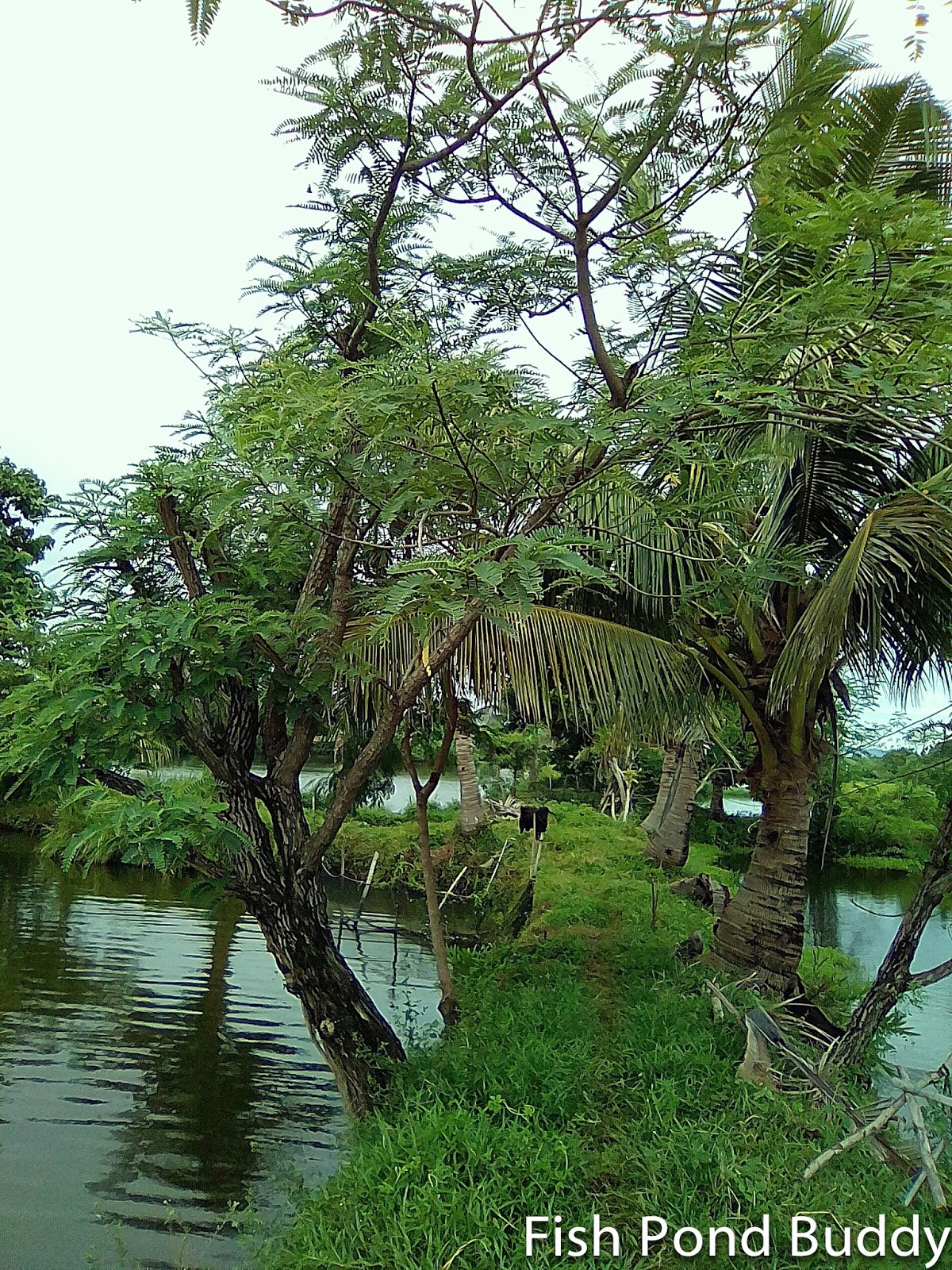
A katuray tree leaning toward our main grow-out pond. It bears white flowers which are also used as veggie ingredients for certain mongo-based dishes, aside from their medicinal use.
 
36. Saluyot - used to relieve fever. Chop the washed fresh leaves of the plant into small pieces, put in a pitcher, add boiled water then let stand for about 10 minutes. Add a little sugar, stir then strain. Drink a glass every eight hours to relieve fever.

Saluyot leaves already picked. Not only are these used medicinally, the leaves are popularly used for veggie dishes.

A saluyot plant growing near our fence

For a complete list of Fish Pond Buddy blog posts on fish farm-related topics, please click the Index page.